
How Montessori Supports Children's Natural Language Development
Language is one of the most extraordinary achievements of early childhood. When placed in language rich environments, children move from silence to fluent speech, from simple words to complex sentences, and eventually to reading and writing—all within the first six years of life. And for many families, children can do it in multiple languages, too!
Dr. Maria Montessori described this process as part of the child’s natural developmental work, guided by what she called the absorbent mind, a unique capacity for unconscious learning present from birth to age six.
The Stages of Language Development: From Birth to Age 6
Birth–6 months: The auditory and receptive stage
Even before birth, infants begin tuning into the sounds of human speech. Newborns can distinguish their mother’s voice and native language rhythms almost immediately. During this period, babies absorb vocabulary, tone, and speech patterns long before producing their own words themselves.
6–18 months: Babbling to first words
Those cute baby babbles? That's your child gradually learning to shape sounds into meaningful messages. Around 12 months, most children begin using their first intentional words. During her extensive work with children, Dr. Maria Montessori observed that speech emerges “spontaneously” when children are immersed in language rich environments rather than through direct instruction. This means providing lots of talking to your child, reading aloud to them, and providing opportunities for them to interact and babble along with others.
18 months–3 years: The explosion of spoken language
In this period, vocabulary grows rapidly, often referred to as the “language explosion.” Sentence formation, grammar, and syntax all begin to develop. Montessori identified this period as part of the sensitive period for language, when children show intense interest in words, naming, conversation, and storytelling.
3–6 years: Refinement, expansion, reading, and writing
As your child grows during the ages of 3 and 6, their language gets more refined as they learn to better articulate sounds, expand their vocabulary, and naturally transition into written language through symbolic representation. Reading in the form of decoding words also happens in this time.
Dr. Maria Montessori’s View of Language Development
Montessori believed that language development is biologically driven, unfolding according to natural developmental laws when children are placed in a language-rich, supportive environment.
Rather than pushing heavy handed, formal instruction, Montessori stressed that a language rich environment include:
Rich conversations
Clear and precise adult speech
Exposure to stories, poetry, and real vocabulary
Respectful listening to the child
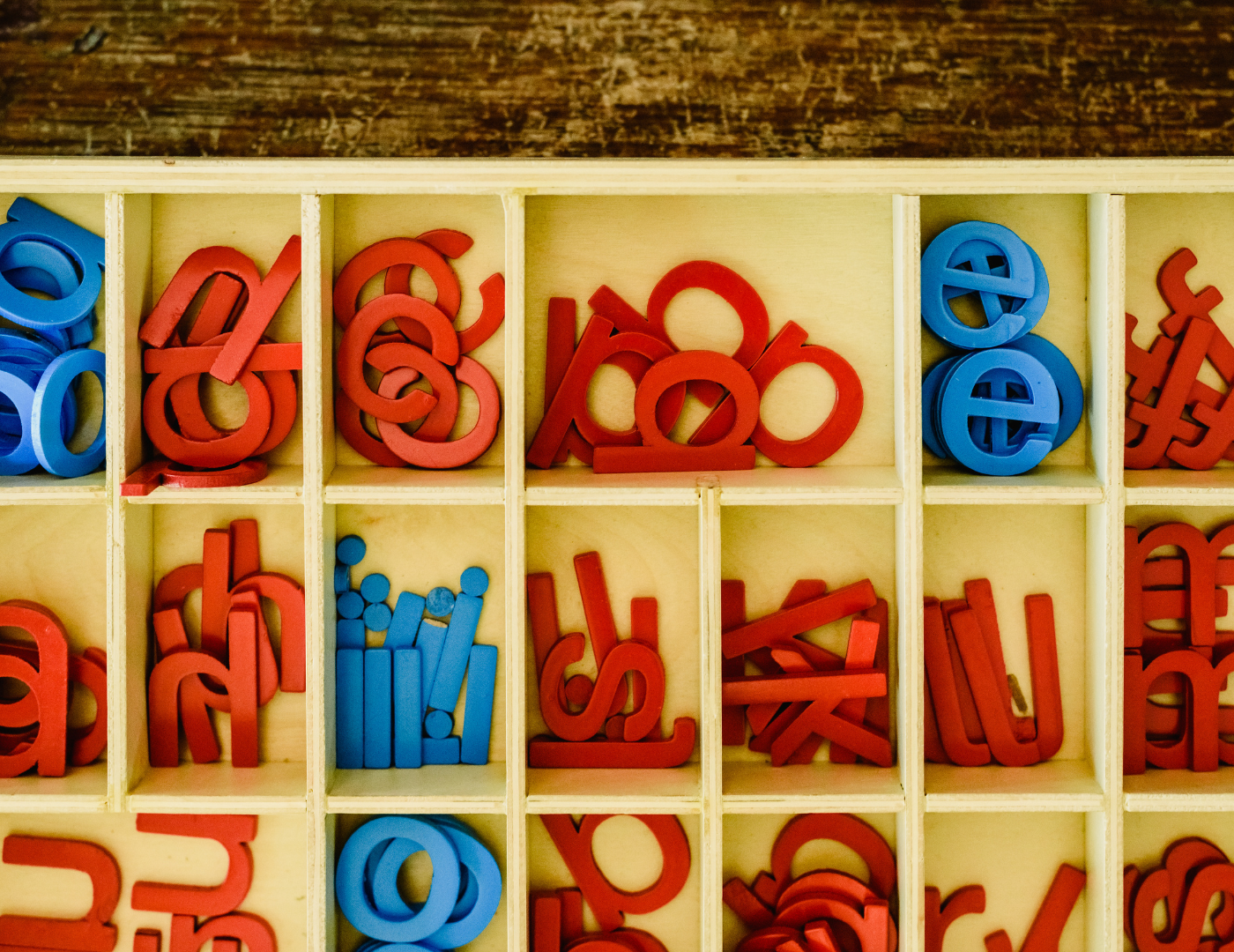
Deep connections between movement and language, which is why so many of the language materials in our Explorers class are hands-on and moveable! From nomenclature cards, to object matching, to the moveable alphabet, to our little library! Our manipulatives and prepared classroom help build your child's language skills in every area of learning.
Behind the Materials - What Language Skills Your Child is Building WHEN THEY WORK
In our prepared class at Wildflower, Montessori language materials are carefully selected and sequenced to fulfill the development needs of the child while appropriately challenging them to learn and master new skills as they show readiness. Each material engages multiple senses while learning and gradually builds from abstract to more concrete.
Vocabulary, Organization, and Language Memory Skills:
Objects and picture cards challenges children to match everyday objects to their corresponding pictures and names.
Three-part cards support precise language with matching images to their proper names and sets
Story baskets and classified nomenclature help bring stories to life with objects and names that help children expand their descriptive and conceptual language.
Preparation for Writing:
Metal Insets develop pencil control and fine motor strength.
Sandpaper Letters reinforce phonetic sounds through repetitive touch and muscle memory.
The Moveable Alphabet allows children to begin building words and sentences before writing by hand.
Practical Life Activities such as pouring, buttoning, and using tongs help your child strengthen their grip and precision to be able to hold a pencil and draw sounds.
Double Lined Paper helps your child practice their handwriting and spacing.
Preparation for Reading
Phonetic object boxes and word cards (Pink, Blue and Green Series) help your child gradually build the decoding skills needed for reading, starting from the simplest 3 letter words with short vowel sounds to more complex sentences with blends, digraphs, long vowels, and more!
Reading classification cards help strengthen your child's reading comprehension and word recognition.
Sequencing cards help your child build reading comprehension and order to stories.
The little library gives your child a cozy space to sit and pick up a book!
Though each child is different and allowed to move at their own developmental pace, many children grow through our materials over time. Children aged 3-4 focus on building motor skills and sound recognition. Children aged 4-5 start building their writing sense and awareness. And children aged 5-6 build their stamina and start putting pencil to paper to write their own words and short sentences.
Click here to learn how you can help your child's language skills develop at home.