
Embracing Home Education for What It Was Always Meant to Be: Not School
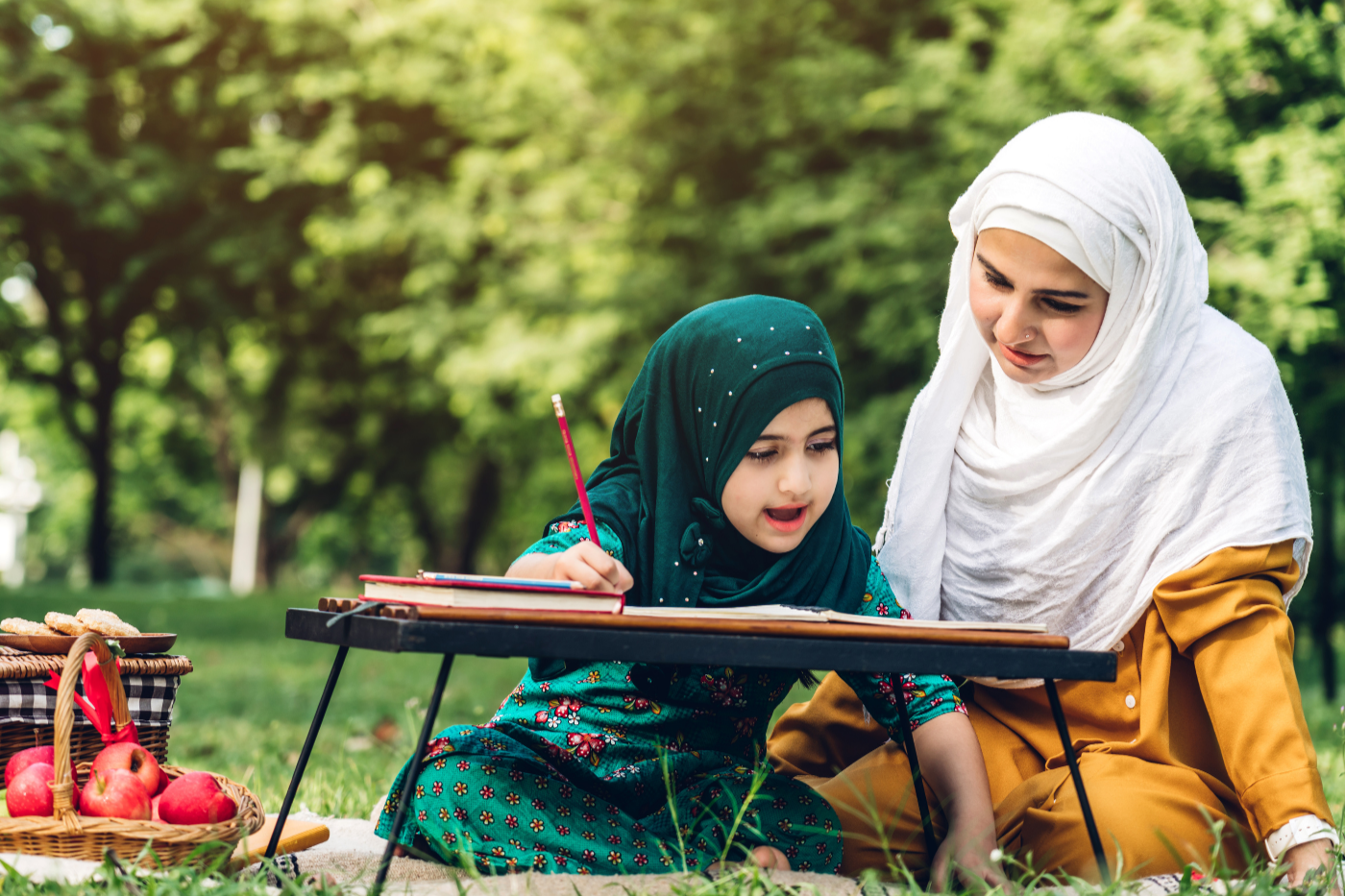
When I first chose to home educate, my oldest child was 4 years old. We had hopefully enrolled him in a local Islamic school for pre-K and he was excited to begin. But after three months of non-stop social struggles, emotional battles, and behavior regressions, we chose to pull him out and keep him at home.
At the time we weren't sure how long he would be home for, but we knew he would need educating of some sort. Naturally, I did what many first time homeschoolers try to do — I turned a portion of my home into a pre-K classroom.
A dry erase schedule went up on the wall, along with a colorful calendar, a poster of the alphabet, and a number line! We used chalk paint to turn another wall into a chalkboard, and I even printed out the NJ state standards for preK and 3-hole punched them into a binder so I could make sure to hit every single one, in English and in Spanish!
I remember when my mother came to visit us that summer, she looked around our home classroom (and at my fabulous binder) and she laughed and laughed.
You see, my mother was a tenured educator. She, who had spent over 30 years teaching pre-K to 6th grade in multiple school districts, knew in that single moment what I wouldn't realize for a long time later: I was trying way too hard. And our homeschool would never last if I insisted on trying to recreate school at home.
What I eventually figured out was that my mistake wasn't in the trying. We try because we love our children and want to give them the best of all that we have to offer. Every mother I know does this.
My mistake was setting my expectations to match a system and structure that was never designed to exist in the environment that we were learning in — our home.
Home, Not School
When we choose to remove our children from school, or to never send them to begin with, we are choosing to take the job of educating them onto ourselves. But what that education looks like in our homes will differ from what it looks like in school.
The reason is simple: our homes are not school systems.
A school (whether public or private) is a state regulated institution designed to offer standardized instruction to large groups of children, preparing them to receive a pre-determined amount of core skills or knowledge in specific areas.
Our homes are highly personal and intimate spaces designed to offer love, care, protection, and a values-based upbringing.
Both places offer knowledge, impart beliefs, and help children grow, but they do it differently.
When your child is being educated at home, learning happens as an extension of your everyday life together, not because the bell struck 9. At home, the way you guide your child's education becomes an extension of your family values and your parenting, not simply a response to state mandates.
Embracing home education requires more than just a change of location. It invites a fundamental shift in how we see education to begin with, how we view ourselves within that role, and how we choose to weave learning into the fabric of our everyday lives.
When we home educate, we are not meant to replicate the systems of teachers, administrators, or institutions. Whether our child learns directly from us, from a tutor, at a co-op, or in an online class, our foundational role remains the same: to be a loving and supportive parent. From that relationship flows guidance, observation, practical support, and a partnership centered on the overall growth and wellbeing of our children.
The Difficulty of Letting Go
Even when we understand a mental shift is needed, embracing the reality in our homeschooling lives is often a different story.
So many of us were raised up and educated inside of traditional school systems. For a large portion of our lives, the rhythms, expectations, and measurements that the school system provided us with was the only definition of learning we ever experienced. This imprints a very specific picture in our mind of what we think learning and success are "supposed" to look like.
Now, here we are, with children of our own to educate, trying to take a meaningful step in a totally different direction — often while moving against the grain of what's considered normal and acceptable to our family, friends, and wider community.
So when we gather our children for a lesson, we're not coming to the table with blank slates or totally open minds. We're showing up with years of mental conditioning and deep-seated beliefs about what our children should be doing and how they should be doing it. Before we know it, we can find ourselves struggling because we are unknowingly recreating the very systems, pressures, and comparisons inside of our homes that we hoped to leave behind.
Letting it go is not as easy as flipping a switch. It takes time and patience. It takes a willingness to move gradually, to notice the impact of our choices, and to question our beliefs about education so we can release the rigidity that no longer serves our families.
Learning to Learn Differently
Learning to do things differently begins with self-awareness. Not judgment, not criticisms, not fast solutions or black and white thinking- just awareness. If you pause and pay attention, what do you notice?
Is your stress rising?
Is your patience wearing thin?
Are comparisons starting to creep in?
Is your child pushing back or failing to measure up?
If so, it may be a sign that rigid school-based expectations are influencing our thinking. It's important to notice when they're happening, reflect on what's triggering it, and figure out how to pivot.
Awareness creates space to ask ourselves what our child truly needs in the moment. Not what the schedule says. Not what the standards demand. Just, what does this child, in this season, on this day genuinely need from me?
This work is not quick nor easy. It asks us to sit with uncertainty, to loosen our sense of control, and to release long-held definitions of learning that once felt safe and familiar. It also asks us to become intimately involved with the inner workings of our children's minds and lives.
This is not work meant to be carried by homeschooling mothers alone.
In too many homeschooling families, the mental and emotional labor of education — the planning, researching, reflecting, worrying, adjusting, maintaining the emotional climate of the home, and proving success to the naysayers in our families and wider community — quietly falls almost entirely on the mother.
Over time, this imbalance can lead to exhaustion, resentment, and burnout.
But home education is not just a schooling choice. It is a choice in the family lifestyle. And lifestyle shifts benefit from shared reflection, shared responsibility, and shared emotional investment from both parents.
When both parents engage in the internal work to question their assumptions, discuss their fears, and redefine learning together — that's when home education can truly take hold. And that's when families can move forward together, rather than one parent carrying the load alone.
In that shared effort, regardless of how you choose to practically divide the labor, trust grows — in the process, in eachother, in your children, and in the unique learning journey unfolding before your family.
Embracing Your Role
Embracing your role as a home educator doesn't mean trying harder or taking on more.
It's more like switching to a different pair of glasses, one that allows you to view your homeschool in the light it was always meant to be: a unique family experience, not just another version of school.
It also means stepping into your position with curiosity, intentionality, and a willingness to learn along the way. As much as you may have chosen home education for your children, it is very much a learning journey for the parents as well.
How you choose to show up on that journey matters. But Alhamdulilah, it never requires perfection, just presence, understanding, and patience with yourself and your children.
Below are some simple practices that can help you along the way. You can begin with one at a time, or mix and match as they suit your family.
1. Family Meetings
Family meetings are a great way to embrace home education as a lifestyle and ensure your homeschool stays flexible, productive and aligned with your family needs.
It's important for parents to talk to one another and for parents to talk with children about all things homeschool. Parents can discuss core values, goals, approaches, and division of labor while children can give important feedback on curriculum, workload, engagement, personal interests, and more.
I would start with monthly meetings and take notes to track what was discussed. At the next meeting, check in on what was discussed previously and see where progress was made and what might need adjusting. Over time, these conversations build deep emotional investment from everyone in the family and help shift the focus to improving the learning process rather than simply comparing results.
2. Get Curious About Your Child's Learning
The other day I took an online practice SAT for reading and writing to get a glimpse at what my teenager would face. He has been studying for the SAT and going through the questions myself immediately helped me understand his frustrations better.
Sometimes, all it takes to relieve tension in homeschooling is to get curious about your child's learning and thought processes. When we judge our children's learning based on our own assumptions and expectations, we can miss a lot of the growth that happens along the way. We also miss opportunities to help them where they need it most.
When we take time to dig into our child's experiences and perspectives, we not only gain insight into their thinking, but we learn how to guide them more effectively.
Talk to your children daily about their learning, interests, and hobbies. Ask them about their struggles and successes. Ask questions, make mental notes, and ask more questions after that. Join them in their passions and games when you can. You don't have to fall in love with the activity itself, but you can fall in love with connecting to your child in ways that matter to them and getting to know sides of them you never knew before.
3. Keep Learning Goals Flexible
Many times we think that if our children learn A, it will automatically lead them to B. But learning and progress often don't happen in a straight line.
James Clear, author of Atomic Habits, says progress happens more in the shape of a spiral staircase, where learning occurs in a series of repetitive loops. Adam Grant, organizational psychologist and author of Hidden Potential, says learning naturally involves stumbling, falling backwards, and periods of discomfort in order to move forward.
By keeping your family's learning goals flexible, you create space for your children to carve their own paths to success. Flexibility allows you to celebrate small wins, adjust the pace when needed, and honor the unique experiences of your children. It also encourages everyone in the family to appreciate learning as an ongoing journey rather than a simple series of fixed checkpoints.
4. Be Your Child's Coach
A parent switching from mom into teacher or principal mode can be a tough pill for homeschooling children to swallow. Just because they're being educated at home doesn't mean they want to view their parents as top-down instructors or office administrators. Putting yourself into coaching mode is often much more helpful for them.
Coaching invites encouragement, support, and a sense of being on the same team. Instead of trying to do and control everything for the child, coaches use resources strategically and guide children toward their strengths. Coaches also know when to step back and let the child lead, take ownership, and solve problems independently.
Taking this approach in your homeschool can help your children feel supported and empowered as they learn — without sacrificing the close, trusting connections between parent and child.
Home education is not about recreating the school system at home — it’s about designing your own systems for learning and growth that align with your family, your values, and your child’s needs. By embracing this journey on your own terms, you give your children the freedom to grow in their own way, and you create a learning experience that is truly yours.